

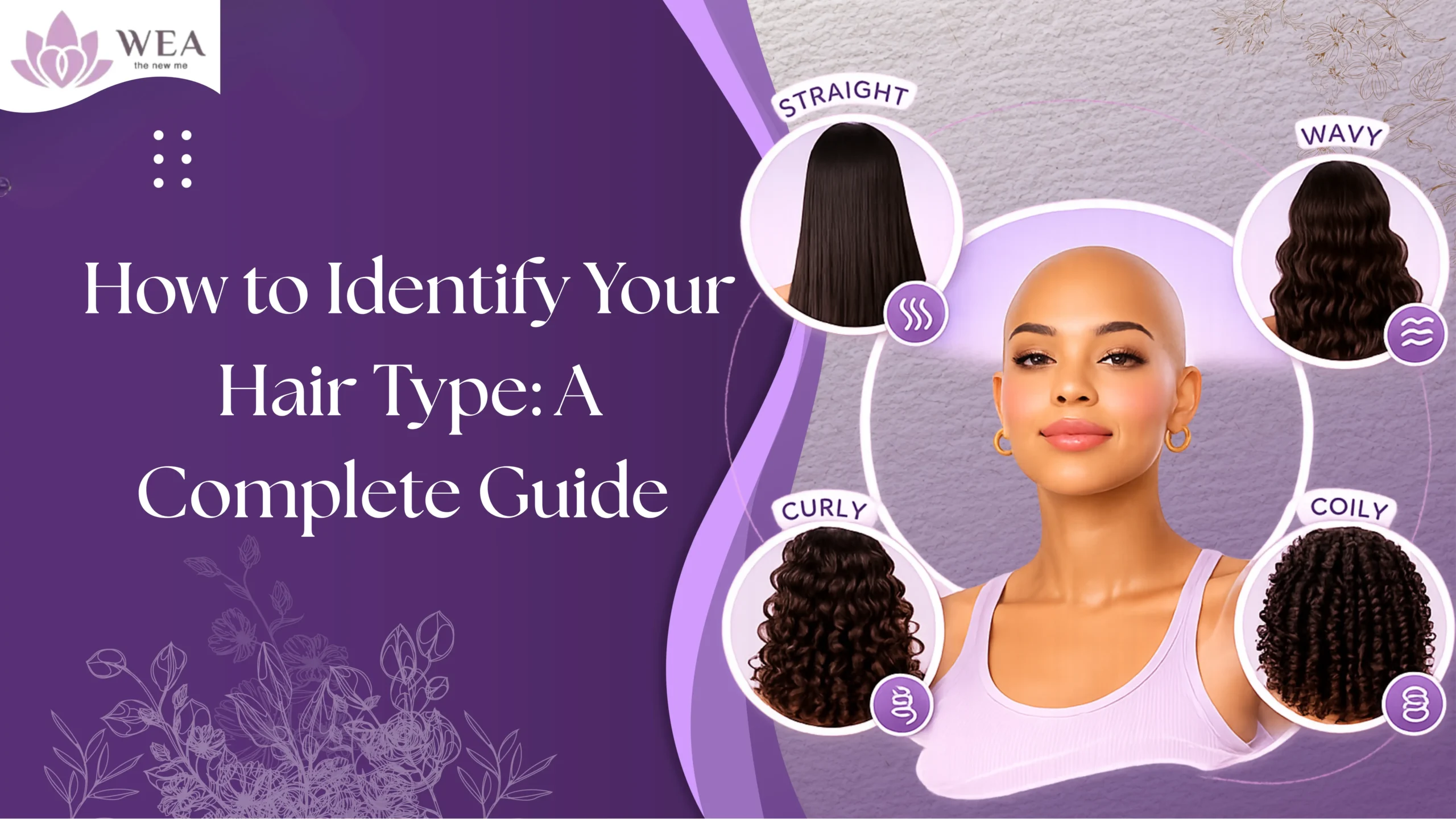
The simplest way to identify your hair type is to wash your hair with shampoo and let it air-dry naturally. Avoid applying styling products, heavy oils or other products that may alter your natural hair pattern before identifying it. Once your hair is completely dry, observe whether it is straight, wavy, curly or coily. You can also assess your hair texture, porosity and scalp condition to better understand your hair and its specific care needs.
There are four main hair types: straight, wavy, curly and coily, and each type can be further divided into subcategories. Hair can also be described by its strand thickness (fine, medium or coarse), porosity (low, medium or high) and scalp condition (oily, dry, balanced or combination). These characteristics can influence how your hair behaves and help you choose a more suitable haircare routine.
Using hair products without understanding your hair type and its characteristics may not give you the results you expect. Understanding your hair pattern, texture, porosity and scalp condition can help you make more informed haircare choices. In this guide, learn how to identify your hair type and understand the specific care needs associated with different hair characteristics.

Written and medically reviewed by Dr. Vatsan V, MBBS, MD – Dermatology, Venereology & Leprosy
Dermatologist at WEA Clinic, Chennai
Dr. Vatsan V provides personalised hair and scalp assessments for concerns such as hair fall, thinning hair, scalp conditions and changes in hair texture. His approach considers individual factors including hair type, hair texture, scalp condition, hair health and specific concerns to provide appropriate haircare guidance and recommend suitable dermatological treatment when needed.
This article is intended for general educational purposes and should not replace an individual consultation with a qualified dermatologist.
What Causes Your Hair Type to Change?
Your hair’s texture, density and natural pattern can change over time. Hormonal changes during puberty, pregnancy and other life stages, as well as ageing and environmental factors, can affect how your hair grows and behaves. As a result, hair may appear straighter, wavier, curlier, finer or coarser. Several factors can influence your natural hair pattern and other hair characteristics, including:
● Genetics: Your genes play an important role in determining your natural hair pattern, strand characteristics and hair density.
● Follicle Shape: The shape and structure of the hair follicle influence the direction and pattern in which hair grows. More circular follicles are generally associated with straighter hair, while more elliptical or asymmetrical follicles are associated with curlier patterns.
● Hormones: Hormonal changes can affect hair growth, density, texture and oil production, which can change how your hair looks, feels and grows.
● Ageing: As you age, changes in hair growth, pigment production and natural oil production can affect the appearance and texture of your hair. Hair may become finer, drier or more fragile over time.
● Environment: Humidity, temperature, sun exposure and pollution can affect the hair’s moisture balance and surface condition. These factors may increase frizz or change how clearly waves, curls or coils are defined.
What Are the Different Hair Types and How Can You Identify Them?
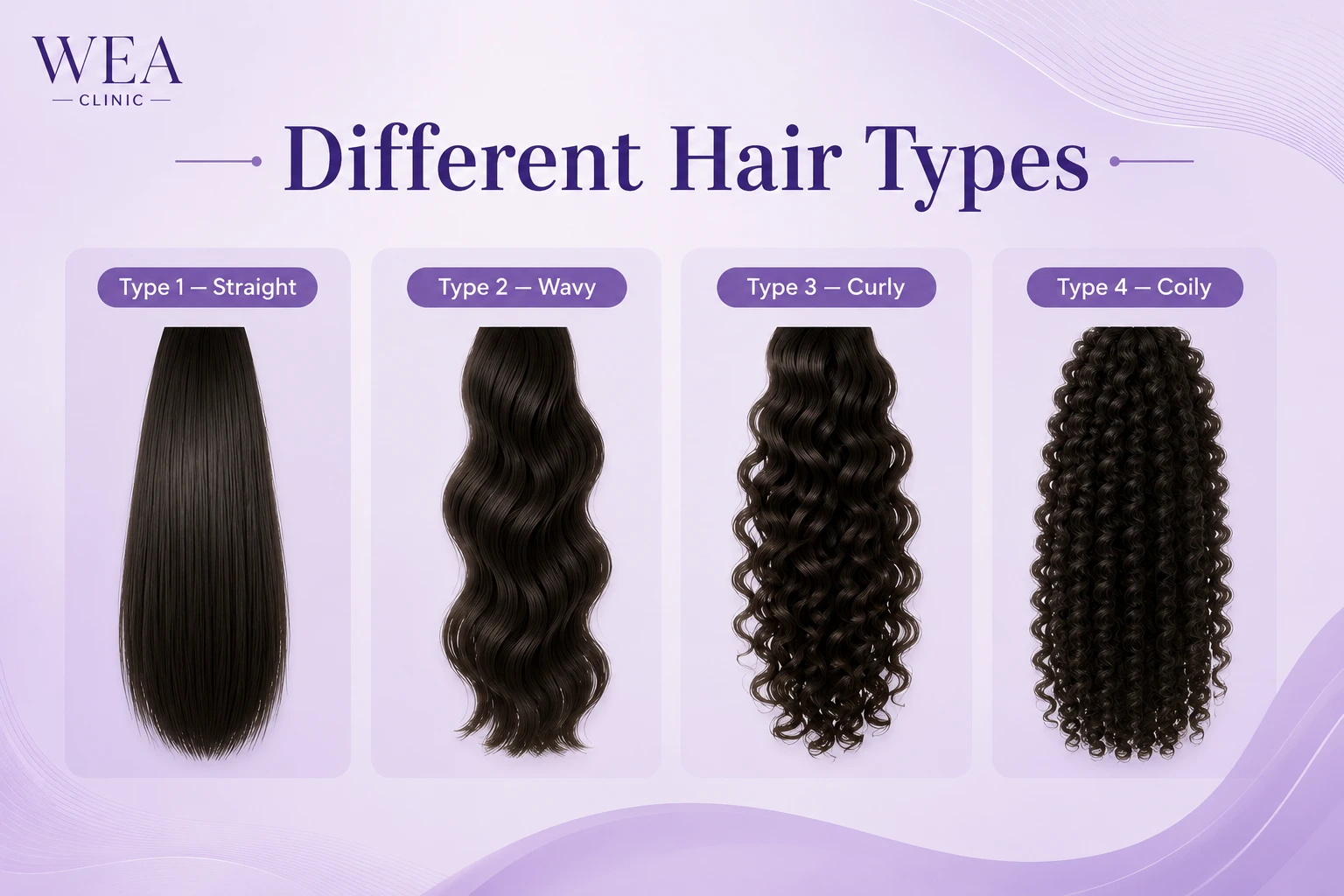
Hair is commonly classified by its natural hair pattern, while characteristics such as strand thickness and porosity provide additional information about how the hair behaves and what type of care it may need. Based on its natural pattern, hair is generally grouped into four main categories: straight, wavy, curly and coily.
Your haircare routine should be based on your natural hair pattern, strand thickness, porosity and scalp condition. Understanding your scalp is just as important as knowing your hair type, particularly if you experience oiliness, dryness or buildup. Since the scalp is skin, understanding how to find your skin type can also help you recognise how your skin tends to behave and choose products more thoughtfully.
1. Based on Natural Hair Pattern
The following classification can help you identify your natural hair type by observing the shape and pattern of your hair after it has been washed and allowed to dry naturally.
Type 1: Straight Hair
Straight hair has little to no visible curl or wave and generally falls naturally from the scalp toward the ends. Its relatively smooth surface can make the hair appear shiny, while scalp oil may spread more easily along the hair shaft.
Some people with straight hair may notice flatness, less volume or an oily appearance, particularly when the scalp produces more oil.
Straight hair is commonly divided into three subtypes:
● 1a: Very straight, fine and usually soft in texture.
● 1b: Straight hair with slightly more body and occasional bends.
● 1c: Straight hair that tends to be thicker or coarser and may have more body than 1a or 1b.
Type 2: Wavy Hair
Wavy hair falls between straight and curly hair. It may form a gentle S-shaped pattern or loose waves, with the hair often appearing straighter near the scalp and becoming more defined toward the mid-lengths and ends.
Wavy hair can range from fine to coarse and may be more prone to frizz and dryness, particularly when the bends in the hair make it harder for natural scalp oils to spread along the hair shaft.
Wavy hair is divided into three subtypes:
● 2a: Fine, loose waves with a subtle S-shaped pattern.
● 2b: More defined S-shaped waves that may be more prone to frizz.
● 2c: Stronger, more defined waves with a tighter pattern that may begin to resemble loose curls.
Type 3: Curly Hair
Curly hair forms visible curls or loops that may range from loose spirals to tighter, spring-like curls. It can vary considerably in density, strand thickness and texture and may be more prone to dryness and frizz because the bends in the hair can make it harder for natural scalp oils to spread along the entire hair shaft.
Curly hair is commonly divided into three subtypes:
● 3a: Loose, well-defined curls with a larger spiral pattern.
● 3b: Tighter, springy curls with a more defined shape.
● 3c: Tight, dense curls with a smaller spiral pattern and noticeable springiness.
Type 4: Coily Hair
Coily hair has very tight curls or coils that may form S-, Z- or zigzag-shaped patterns. It can experience significant shrinkage and may be more susceptible to dryness and breakage, so appropriate moisture and gentle handling can be particularly important.
Coily hair is commonly divided into three subtypes:
● 4a: Tight, well-defined coils with an S-shaped pattern.
● 4b: Coils with a less-defined, Z-shaped or zigzag pattern.
● 4c: Very tight coils with less visible definition and significant shrinkage.
How to Identify Your Hair Type at Home
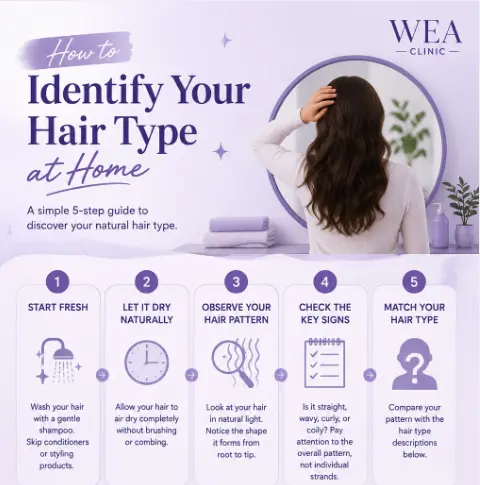
You can identify your natural hair pattern by observing your hair after washing it.
- 1. Wash your hair with shampoo and rinse thoroughly.
- 2. Avoid applying styling products, heavy oils or other products that may alter your natural hair pattern.
- 3. Allow your hair to dry naturally without deliberately stretching, twisting or styling it.
- 4. Once your hair is completely dry, observe its natural pattern:
- Straight hair: Falls straight with little to no visible wave or curl.
- Wavy hair: Forms gentle bends or an S-shaped pattern.
- Curly hair: Forms visible loops, spirals or ringlets.
- Coily hair: Forms very tight coils or a defined zigzag pattern.
Remember: Your hair may have more than one natural pattern, and its appearance can vary depending on humidity, products, styling and hair damage. The purpose of identifying your hair type is to understand its natural pattern rather than place it into a rigid category.
Based on Hair Texture
Hair texture refers mainly to the thickness or diameter of individual hair strands. It is commonly described as fine, medium or coarse.
- Fine hair: Fine strands have a smaller diameter and may feel soft or delicate. They can be more prone to tangling and may become weighed down easily by heavy products.
- Medium hair: Medium-textured hair has strands of intermediate thickness and generally offers a balance between manageability and styling versatility.
- Coarse hair: Coarse hair has a larger strand diameter and may feel thicker or more wiry when touched. It can require more conditioning and moisture, particularly when the hair is dry or chemically treated.
Based on Hair Porosity
Hair porosity describes how easily the hair strand absorbs and retains moisture. It is commonly grouped into low, medium and high porosity.
- Low porosity: The hair cuticle may make it more difficult for moisture to enter the hair shaft, and products can sometimes remain on the surface.
- Medium porosity: The hair generally absorbs and retains moisture relatively well and is often easier to maintain.
- High porosity: The hair can absorb moisture readily but may also lose it more quickly. Hair that is damaged by heat, chemical treatments or excessive styling may develop higher porosity.
Can You Test Hair Porosity at Home?
A commonly shared home method is the water-glass test, where a clean strand of hair is placed in a glass of water. However, this test should only be considered a rough indication rather than a definitive way to determine porosity. Product buildup, hair damage and other factors can affect how a strand behaves in water.
For a more accurate understanding of your hair’s condition and moisture needs, a professional hair and scalp assessment may be more useful.
Based on Scalp Condition
Sebaceous glands in the scalp produce sebum, an oily substance that helps lubricate and protect the scalp and hair. The amount of sebum produced can influence how oily or dry the scalp feels.
Scalp condition can generally be described as oily, dry, balanced or combination.
- Oily scalp: Excess sebum can make the scalp and hair appear greasy or oily, sometimes requiring more frequent cleansing.
- Dry scalp: A dry scalp may feel tight, flaky or itchy and can be associated with reduced oil production or other scalp conditions.
- Balanced scalp: The scalp produces an appropriate amount of oil without excessive greasiness or persistent dryness.
- Combination scalp: The scalp may become oily while the mid-lengths and ends of the hair remain dry or rough. This can occur because natural scalp oils do not spread evenly along the hair shaft.
How Should You Care for Different Hair Types?
Your haircare routine should be based on your natural hair pattern, strand thickness, porosity and scalp condition. There is no single routine that works equally well for everyone. The goal is to cleanse the scalp, maintain moisture and reduce unnecessary dryness, frizz and breakage while considering how your particular hair behaves.
1. How to Care for Straight Hair
Straight hair may become oily more quickly because scalp oils can spread along the hair shaft more easily. Wash your hair according to how oily or dirty your scalp becomes rather than following a fixed schedule.
If your scalp tends to become oily quickly, understanding why your skin produces excess oil can also help you make sense of your scalp’s behaviour. Factors such as product buildup, environmental conditions and individual oil production can all affect how oily the scalp feels.
 Learn more about oily skin and what can contribute to excess oil production →
Hair care tips:
- Choose a gentle shampoo suited to your scalp and cleanse the scalp thoroughly without unnecessarily scrubbing the lengths.
- Use a lightweight conditioner, particularly if your hair is fine or becomes weighed down easily.
- Apply conditioner mainly to the mid-lengths and ends if your roots become oily quickly.
- If your hair lacks volume, lightweight styling products can help add body without making the hair feel heavy.
- Avoid applying heavy oils or rich products close to the scalp if they make your hair greasy or flat.
2. How to Care for Wavy Hair
Wavy hair can become frizzy or dry, particularly when it is exposed to humidity, excessive heat or rough handling. A suitable routine should help maintain moisture while allowing the natural wave pattern to remain defined.
Hair care tips:
- Wash your hair when your scalp becomes oily or has product buildup rather than relying on a fixed number of days.
- Use a gentle shampoo and concentrate cleansing mainly on the scalp.
- Apply conditioner to the lengths and ends after washing.
- A lightweight leave-in conditioner can be useful if the hair feels dry or becomes difficult to manage.
- Apply leave-in products to damp hair and gently scrunch the lengths to encourage the natural wave pattern.
- Limit excessive heat styling, which can contribute to dryness and hair damage.
3. How to Care for Curly Hair
Curly hair tends to be more susceptible to dryness and breakage because the bends in the hair can make it more difficult for scalp oils to spread along the entire hair shaft. Gentle cleansing, regular conditioning and careful detangling can help maintain the curl pattern.
Hair care tips:
- Cleanse the scalp based on your scalp condition and haircare needs rather than following a fixed weekly schedule.
- Apply shampoo mainly to the scalp and allow the lather to cleanse the lengths as it is rinsed.
- Use conditioner regularly to help improve softness and manageability.
- Detangle curly hair gently, preferably when it is wet and conditioned, using your fingers or a suitable wide-toothed comb.
- A curl-defining product can help enhance the natural curl pattern if needed.
- If using a diffuser, choose a lower heat setting and avoid excessive heat exposure.
4. How to Care for Coily Hair
Coily hair has a tightly curved pattern and can be particularly prone to dryness, tangling and breakage. Gentle handling and regular conditioning are important for maintaining its moisture and reducing mechanical damage.
Hair care tips:
- Use a gentle shampoo and focus cleansing on the scalp rather than repeatedly scrubbing the hair lengths.
- Cleanse according to your scalp’s needs and the amount of oil or product buildup present.
- Use a rich conditioner or deep-conditioning treatment when the hair feels dry or difficult to manage.
- Detangle gently while the hair is wet and well-conditioned to reduce pulling and breakage.
- A moisturising leave-in product can help improve softness and manageability between washes.
- Minimise excessive heat and tight hairstyles that place repeated tension on the hair.
When Should You See a Dermatologist for Hair or Scalp Concerns?
A change in your hair does not always mean there is an underlying problem. However, persistent hair fall, noticeable thinning, sudden changes in hair texture or ongoing scalp symptoms may need more than changes to your haircare routine.
Consider seeing a dermatologist if you notice:
- Hair fall that continues for several weeks or becomes noticeably heavier than usual.
- Gradual thinning, widening of the hair part or visible areas of reduced hair density.
- Sudden bald patches or clearly defined areas of hair loss.
- Persistent itching, redness, scaling, flaking or irritation of the scalp.
- Repeated scalp problems that do not improve with a suitable haircare routine.
- Hair breakage or changes in hair quality that continue despite reducing heat, chemical treatments or tight hairstyles.
A dermatologist can examine the scalp and hair more closely and help determine whether the concern is related to haircare practices, scalp conditions, nutritional factors, hormonal changes or other underlying causes. Getting the cause assessed early can also help avoid trying multiple products without knowing what your hair or scalp actually needs.
Why Choose WEA Clinic for Hair and Scalp Concerns?
At WEA Clinic in Chennai, hair and scalp concerns are assessed based on the individual’s symptoms, scalp condition and pattern of hair changes rather than simply recommending the same routine for everyone. A dermatology consultation can help identify what may be contributing to hair fall, thinning or scalp problems and whether further evaluation or treatment is appropriate.
If your haircare routine is not addressing a persistent concern, a professional assessment can be a useful next step before trying more products or treatments on your own.
Key Takeaways
- Hair is commonly classified as straight, wavy, curly or coily, while texture, porosity and scalp condition provide additional information about its care needs.
- You can identify your natural hair pattern by observing it after washing and allowing it to dry naturally without products that alter its shape.
- Fine, medium and coarse hair describe the thickness of individual hair strands, while porosity describes how the hair absorbs and retains moisture.
- Your scalp may be oily, dry, balanced or combination, and your cleansing routine should take your scalp condition into account.
- Haircare needs can change with age, hormonal changes, environmental conditions, chemical treatments, heat styling and other factors.
- Curly and coily hair may require more attention to conditioning and gentle handling because their natural shape can make the hair more susceptible to dryness and breakage.
Frequently Asked Questions
1. How can I identify my hair texture?
Hair texture refers to the thickness or diameter of an individual hair strand. Fine strands generally feel delicate, medium strands have an intermediate thickness, and coarse strands have a larger diameter and may feel thicker or more wiry.
2. What is a good basic haircare routine?
A basic routine includes regular scalp cleansing with a suitable shampoo, conditioning the hair lengths and ends, gentle detangling and limiting excessive heat or chemical treatments. The ideal frequency depends on your scalp condition, hair type and individual needs.
3. How do I know what type of hair I have?
Wash your hair, avoid products that can change its natural pattern and allow it to dry naturally. Then observe whether it falls straight, forms waves, creates curls or develops tight coils. Your hair may also contain more than one natural pattern.
4. How can I tell if my hair is wavy or just frizzy?
Wavy hair has a recognisable natural pattern, such as gentle bends or an S-shaped pattern. Frizz refers to strands that appear raised, irregular or out of alignment with the main hair pattern. Hair can be both wavy and frizzy at the same time.
5. Are hair density and hair volume the same?
No. Hair density refers to the number of hair strands growing within a particular area of the scalp. Hair volume describes how much space the hair appears to occupy and can be influenced by hair length, texture, styling and natural fullness.

