
Male Breast Reduction(Gynecomastia) Surgery in Chennai: Cost & Types
 By WEA Clinic

Medically reviewed (22 October 2026) by Dr. Aishwarya V. L., Plastic Surgeon, WEA Clinic, Velachery, Chennai. This article is for informational purposes and does not replace a personal consultation with a qualified doctor.
Direct Answer:
Gynecomastia surgery in Chennai
Gynecomastia surgery (male breast reduction) in Chennai removes excess glandular tissue, fat or both to reduce chest enlargement. At WEA Clinic, Velachery, Dr. Aishwarya V. L., Visiting Consultant Plastic Surgeon, provides consultations for surgical concerns. The estimated surgery cost ranges from ₹30,000 to ₹1,50,000, depending on the technique, complexity and whether skin removal is needed. Surgical techniques may include liposuction, gland excision or a combination of both. Surgery is usually performed in one operation. Scars are expected, and recovery varies with the procedure and individual healing.
Key Facts at a Glance
| Question | Quick answer |
|---|---|
| Cost in Chennai | ₹30,000–₹1,50,000 at WEA Clinic |
| Methods | Tissue removal, liposuction or both |
| Light activity | Usually within 1–2 weeks |
| Full recovery | Around 4–6 weeks |
| Final results settle | Over several weeks to months |
| Scars | Expected; visibility varies |
| Nipple sensation | May change after surgery |
| Minimum age | Usually 18+; individual assessment needed |
| Pain relief | May reduce breast-related back and shoulder pain |
| Book consultation | Several weeks before your preferred surgery date |
Chest still looks enlarged despite exercise?
You may have lost weight, built your chest muscles and changed your diet, yet your nipples still look puffy or your chest remains rounded under a T-shirt. You might avoid swimming, fitted clothes, changing rooms or situations where you need to remove your shirt.
This can happen because male chest enlargement is not always caused by fat alone. Enlarged glandular tissue can remain even after weight loss. Exercise can strengthen chest muscles, but it does not reliably remove established glandular tissue.
The first step is to establish what is contributing to the enlargement. Fat, glandular tissue and loose skin can require different approaches.
What causes male breast enlargement?
Common causes and contributing factors include:
- Puberty and hormonal changes: Breast tissue may enlarge during adolescence. Some cases resolve over time, while persistent enlargement may need assessment.
- Medicines: Certain prescribed medicines can contribute to breast enlargement. Do not stop medication without consulting the prescribing clinician.
- Anabolic steroids and other substances: These may contribute to breast tissue changes and should be discussed during the consultation.
- Medical conditions: Hormonal, liver, kidney and other health conditions can sometimes contribute.
- Weight changes: Increased chest fat can create fullness, while substantial weight loss may leave loose skin.
Can men produce milk due to gynecomastia?
Gynecomastia itself does not usually cause milk production. However, men can rarely develop milky nipple discharge, a condition called galactorrhea, which may be associated with elevated prolactin levels, certain medications or other medical conditions. Any nipple discharge in men should be evaluated by a doctor rather than assumed to be caused by gynecomastia.
New or rapidly changing enlargement, a hard one-sided lump, nipple discharge or skin changes should be medically assessed.
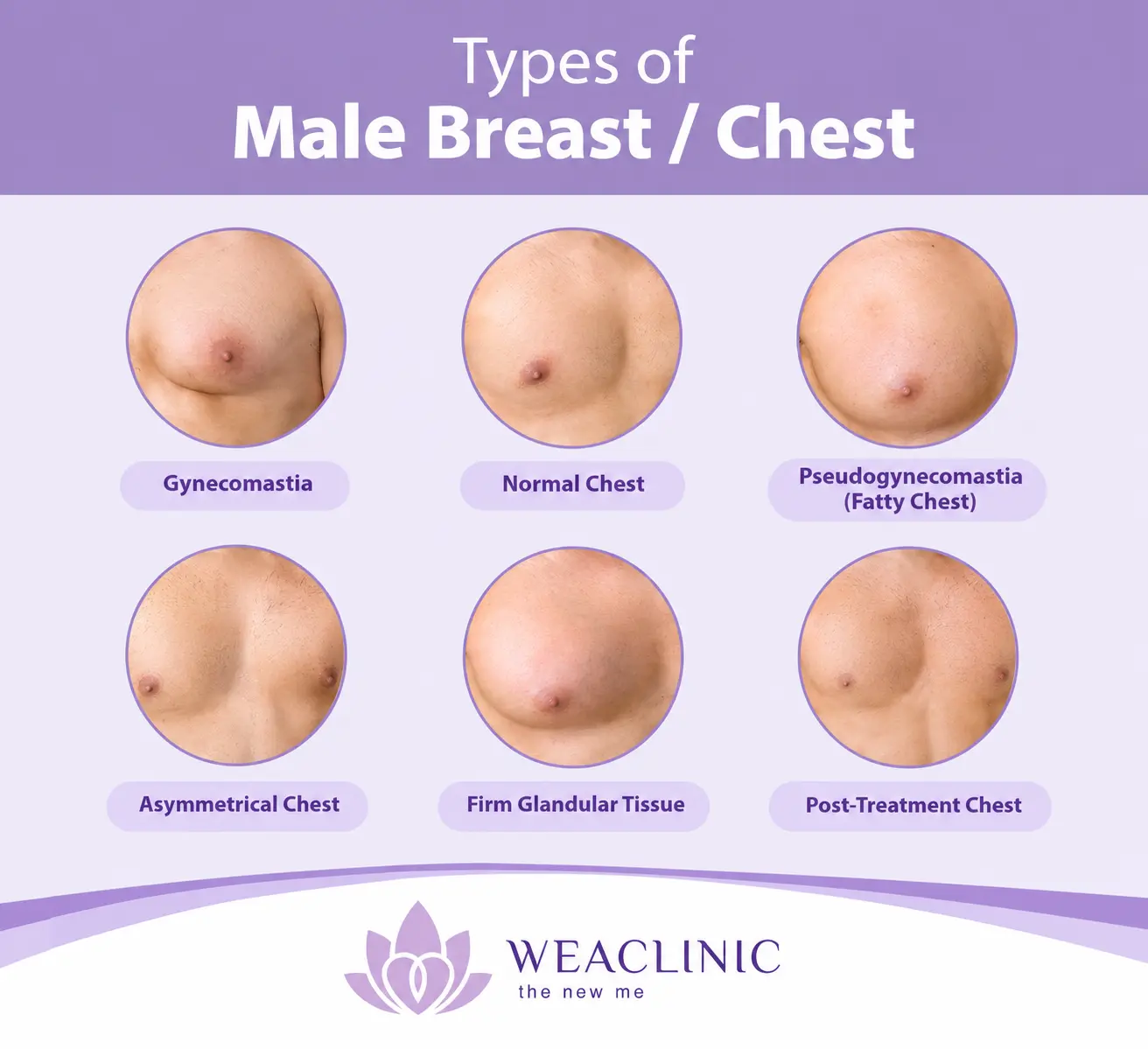
Chest fat or glandular gynecomastia: what is the difference?
| Concern | Chest fat (pseudogynecomastia) | Glandular gynecomastia |
|---|---|---|
| Main cause | Excess fat around the chest | Enlargement of breast gland tissue, sometimes with fat |
| Effect of weight loss | Fullness may decrease | Glandular tissue may remain |
| Puffy nipples | Fat may contribute to a rounded appearance | Tissue beneath the nipple may contribute to puffiness |
| Possible surgical approach | Liposuction in suitable cases | Gland excision, liposuction or a combination |
Both can occur together. A clinical examination helps determine which tissues contribute to the enlargement.
What are the types of gynecomastia surgery?
The technique depends on the amount of fat, glandular tissue and loose skin present.
| Type or presentation | Possible approach | Main purpose |
|---|---|---|
| Fat-dominant chest enlargement | Liposuction | Remove excess fatty tissue |
| Glandular enlargement | Gland excision | Remove excess breast gland tissue |
| Mixed gynecomastia | Liposuction with gland excision | Address both fat and glandular tissue |
| Enlargement with substantial loose skin | Tissue removal with possible skin excision | Reduce excess skin and improve contour |
These are general treatment approaches, not procedures every patient needs. The surgeon selects the appropriate technique after assessment.
What techniques and devices are used?
1. Liposuction
Liposuction uses a thin tube called a cannula, connected to a suction system, to remove excess fat through small incisions. It may be suitable when fatty tissue is a major contributor to chest fullness.
2. Surgical gland excision
Gland excision removes excess glandular tissue through a surgical incision, often positioned along part of the lower edge of the areola. Instruments such as a scalpel, scissors and forceps may be used.
3. Combined liposuction and gland excision
When both fat and firm glandular tissue contribute to enlargement, the surgeon may use liposuction to reduce fatty fullness and excision to remove the remaining glandular tissue.
4. Skin excision
When significant loose skin remains, additional incisions may be required to remove it. In selected cases, repositioning of the nipple–areola complex may also be considered.
Which devices are used? Common equipment can include a liposuction cannula and suction system, standard surgical instruments, cautery equipment for bleeding control, and instruments for wound closure. Specialised liposuction systems may be used in some practices, but no particular branded device should be assumed.
How Much Does Gynecomastia Surgery Cost at WEA Clinic?
Gynecomastia surgery at WEA Clinic, Velachery, Chennai, has an estimated overall cost of ₹30,000–₹1,50,000. The final price depends on whether the procedure requires liposuction, gland excision, a combination of techniques or additional skin removal.
Gynecomastia Surgery Cost in Chennai: Procedure-Wise Breakdown
| Surgery type | Estimated cost | Typically considered for |
|---|---|---|
| Liposuction alone | ₹30,000–₹1,20,000 | Fat-dominant chest enlargement |
| Gland excision alone | ₹30,000–₹80,000 | Prominent glandular tissue, including some cases of puffy nipples |
| Liposuction + gland excision | ₹50,000–₹1,20,000 | Enlargement involving both fat and glandular tissue |
| Liposuction + gland excision + skin removal | ₹80,000–₹1,50,000 | Significant enlargement with excess or loose skin |
| Overall estimated cost | ₹30,000–₹1,50,000 | Depends on the individual assessment and surgical plan |
These are indicative estimates, not a confirmed quotation for each procedure. The appropriate technique depends on the clinical examination, tissue composition, skin elasticity and extent of enlargement. Gynecomastia grade alone does not determine the procedure or final cost.
Make A Call : 8270582706
Make a CHAT : Whatsapp
What Affects the Final Surgery Cost?
- Surgical technique: Liposuction, gland excision or both may be required.
- Excess skin: Additional skin removal can affect the overall cost.
- Anaesthesia and facility charges: These depend on the planned procedure and arrangements.
- Medical evaluation: Investigations, medicines and follow-up may affect the total.
- Revision surgery: Corrective surgery may have a different cost from a first-time procedure.
Before proceeding, request an itemised quotation from WEA Clinic. Confirm whether the quoted price includes the surgeon’s fee, anaesthesia, facility charges, investigations, compression garment, medicines and follow-up visits.
How long does gynecomastia surgery take?
Gynecomastia surgery commonly takes around 1.5–3 hours as a general estimate, although the duration varies according to the technique and complexity. Procedures involving extensive skin removal may take longer.
The total time at the facility also includes preparation, anaesthesia and postoperative observation. WEA Clinic’s typical operating time should be confirmed with the treating surgeon rather than assumed for every patient.
What tests are needed before surgery?
Not every patient requires the same tests. The surgeon reviews the medical history, examines the chest and determines whether further investigation is necessary.
Possible assessments include:
- Blood tests: A complete blood count and other preoperative tests may be requested.
- Hormone tests: These may be recommended when symptoms or examination findings suggest a hormonal cause.
- Liver, kidney or thyroid tests: These may be indicated by the patient’s medical history or clinical findings.
- Breast imaging: Ultrasound or other imaging may be recommended when the diagnosis is uncertain or a lump requires investigation.
- Anaesthesia assessment: Relevant health conditions, allergies, medicines and previous anaesthesia experiences are reviewed before surgery.
Not every patient needs every test. The investigations are selected according to the clinical findings and planned procedure.
Before surgery, disclose all prescription medicines, supplements, allergies, smoking and alcohol use. Follow the surgeon’s specific instructions about fasting and medication. Do not stop prescribed medicines unless instructed by your clinician.
How is gynecomastia surgery performed step by step?
The exact operation varies depending on the patient’s anatomy and the selected technique. A typical surgical process includes the following stages.
Step 1: Consultation and examination
The surgeon evaluates chest enlargement, skin quality, medical history and the patient’s concerns. The assessment helps distinguish fat, glandular tissue and excess skin.
Step 2: Surgical planning
The surgeon discusses the recommended technique, likely incision locations, expected scars, risks, alternatives and estimated cost. Surgical markings may be made before the operation.
Step 3: Anaesthesia
The procedure may be performed under general anaesthesia or, in selected cases, local anaesthesia with sedation. The appropriate option depends on the operation and the patient’s circumstances.
Step 4: Making the incisions
Small incisions provide access for liposuction. If glandular tissue needs removal, an incision may be made near the edge of the areola. Skin removal requires additional incisions when indicated.
Step 5: Removing excess fat
When liposuction is required, the surgeon uses a cannula connected to a suction system to remove the planned amount of fatty tissue.
Step 6: Removing glandular tissue
If enlarged glandular tissue remains, the surgeon removes the planned tissue through an appropriate incision. Liposuction and gland excision can be combined when both tissue types contribute to enlargement.
Step 7: Skin removal and contouring
In selected cases, excess skin is removed. The surgeon aims to create a balanced chest contour while avoiding excessive tissue removal, which can contribute to a sunken appearance.
Step 8: Closing the incisions
The incisions are closed with appropriate sutures and dressings. A drain may be used if clinically indicated, and a compression garment may be recommended.
Step 9: Postoperative monitoring
The patient is monitored after surgery and receives instructions about wound care, medication, activity restrictions and follow-up. Discharge timing depends on the procedure and clinical assessment.
Does gynecomastia surgery hurt?
Discomfort, tightness, bruising and swelling can occur after surgery. The degree and duration vary with the procedure and individual healing. The treating team provides instructions about pain relief and wound care.
Severe or increasing pain, rapidly increasing swelling, fever or concerning wound changes require prompt medical attention.
What are the risks of gynecomastia surgery?
Possible risks include:
- Bleeding or a collection of blood beneath the skin (haematoma).
- Fluid collection beneath the skin (seroma).
- Infection or delayed wound healing.
- Anaesthesia-related complications.
- Visible or unfavourable scars.
- Changes in nipple or chest sensation.
- Uneven contours, persistent fullness or a sunken appearance.
- Asymmetry or dissatisfaction with the result.
- The possibility of additional treatment or revision surgery.
Individual risk depends on health, the procedure and healing. Discuss the risks and expected benefits with the surgeon before deciding.
Seek emergency medical attention for chest pain, shortness of breath or fainting after surgery. Contact the treating team promptly for increasing pain, unusual swelling, fever, wound redness or discharge.
Aftercare following gynecomastia surgery
Following postoperative instructions helps support healing and allows complications to be identified promptly.
| Aftercare area | What patients should know |
|---|---|
| Compression garment | Wear it as directed by the surgeon to support the chest during healing. |
| Wound care | Follow instructions for dressings, incisions and any drain. |
| Medication | Take prescribed medicines as directed and ask before adding other medicines or supplements. |
| Showering | Follow the clinic’s instructions about when and how to shower. |
| Daily activity | Resume gentle movement and routine activities gradually as advised. |
| Work and driving | Return when safe for your recovery, medication use and job demands. Do not drive while impaired. |
| Gym and heavy lifting | Avoid strenuous exercise and chest workouts until cleared by the surgeon. |
| Follow-up visits | Attend appointments so healing, swelling and chest contour can be assessed. |
| Scar care | Begin scar treatments only when the incisions have healed sufficiently and the surgeon approves them. |
Recovery differs between patients. Do not rely on a fixed timeline for returning to work, driving or exercise without advice from the treating team.
Will I need drains or an overnight stay?
A drain may be used when the surgical team considers it necessary; not every patient needs one. Some procedures are suitable for day surgery, while others may require observation depending on the operation, health status and facility arrangements.
The anaesthesia plan, discharge arrangements and need for a drain should be explained before surgery.
Can surgery leave puffy nipples, a sunken chest or visible scars?
Yes. Surgery aims to improve chest contour, but perfect symmetry and invisible scars cannot be guaranteed.
| Concern | What may contribute |
|---|---|
| Persistent puffy nipples | Swelling, residual glandular tissue or underlying anatomy |
| Sunken or crater-like contour | Excessive or uneven tissue removal |
| Uneven chest shape | Natural asymmetry or differences in healing |
| Visible scars | Incisions needed to access and remove tissue |
| Nipple sensation changes | Nerves may be affected during surgery |
Scars may become less noticeable as healing progresses, but they do not always disappear. Early swelling can also affect the appearance of the chest.
How long does recovery take?
Recovery depends on the extent of surgery, the technique used, your health and your daily activities.
- Desk work: Return when discomfort and movement allow, following the surgeon’s advice.
- Walking: Gentle movement may be encouraged early, depending on the procedure.
- Driving: Do not drive while affected by anaesthesia, sedating medication, pain or restricted movement.
- Sleeping: Follow advice about positioning and avoiding pressure on the chest.
- Travel: Plan longer journeys around recovery and access to follow-up care.
- Gym workouts: Wait for medical clearance before resuming strenuous exercise.
- Final appearance: Swelling settles gradually, and scars and chest contour continue to change during healing.
Can gynecomastia return after surgery?
Results can be long-lasting, but chest appearance may change if contributing factors persist or develop later. Certain medicines, anabolic steroids, hormonal conditions and substantial weight changes may be relevant.
Tell your clinician about medicines, supplements and bodybuilding products you use. Do not stop prescribed medication without medical advice. If an underlying medical cause is suspected, it should be evaluated.
Is surgery different for men over 40, steroid users or people who have lost significant weight?
Men over 40: New or changing breast enlargement should be medically assessed rather than automatically treated as a cosmetic concern.
Men who use anabolic steroids: Steroid use can be relevant to breast enlargement and recurrence risk. Disclose current and past use during the consultation.
Men who have lost significant weight: Fat may decrease while loose skin remains. Assessment helps determine whether fat removal, gland excision, skin removal or a combination may be appropriate.
The treatment plan depends on individual findings rather than age or weight alone.
Can diet, exercise or medicine remove gynecomastia without surgery?
Weight management may reduce chest fat, but exercise does not reliably remove established glandular tissue. If a medicine or medical condition contributes to enlargement, a clinician may investigate the cause and discuss suitable treatment.
Surgery may be considered when enlargement persists and the benefits, risks and alternatives have been discussed. Products that promise to dissolve breast tissue should not replace a medical assessment.
What if I am unhappy with the result?
Early swelling can affect chest shape, so the initial appearance may not represent the final result. Persistent fullness, asymmetry or nipple contour changes should be reviewed by the treating team.
Revision surgery may be considered in selected cases, but it is not always necessary and cannot guarantee a perfect result. Discuss the clinic’s follow-up policy and any potential additional costs before surgery.
Choosing a plastic surgeon for gynecomastia surgery in Chennai with reviews
When comparing options, consider the surgeon’s qualifications, relevant experience, explanation of risks, follow-up arrangements and clarity about costs.
Dr. Aishwarya V. L. is listed by WEA Clinic as a Visiting Consultant Plastic Surgeon with MBBS, MS (General Surgery) and MCh (Plastic & Reconstructive Surgery) qualifications.
Read Dr. Aishwarya’s profile at WEA Clinic.
Practo Dr. Aishwarya’s profile at PRACTO
Frequently Asked Questions About Gynecomastia Surgery in Chennai
1. How much does gynecomastia surgery cost at WEA Clinic?
The estimated cost is ₹30,000–₹1,50,000. The final quotation depends on the procedure, complexity and whether skin removal is needed.
2. Which technique is best for gynecomastia?
Liposuction, gland excision or a combination may be appropriate. The choice depends on the amount of fat, glandular tissue and excess skin.
3. How long does gynecomastia surgery take?
A general estimate is around 1.5–3 hours, but the duration varies with the technique and complexity. Confirm the expected operating time with the treating surgeon.
4. Will my chest look natural after surgery?
The aim is a balanced chest contour. Anatomy, skin elasticity, tissue removal and healing influence the result, and perfect symmetry cannot be guaranteed.
5. Will the scars be visible when I remove my shirt?
Scars are expected, and their location and visibility depend on the technique. They may fade over time but cannot be guaranteed to disappear.
6. Can puffy nipples or a sunken chest remain after surgery?
Yes. Residual tissue, swelling or uneven tissue removal can affect the contour. Surgical planning aims to reduce these risks.
7. What tests are needed before surgery?
Tests depend on the medical history and examination. Blood tests, hormone investigations, imaging or anaesthesia assessment may be recommended when indicated.
8. Will I need drains or an overnight stay?
Not every patient needs a drain or overnight observation. The plan depends on the procedure, health status and facility arrangements.
9. Can gynecomastia return after surgery?
Chest appearance can change if contributing factors persist or develop later. Discuss medicines, steroid use and possible underlying medical causes with your clinician.
10. When can I return to work and the gym?
Timing depends on the procedure and job or exercise demands. Resume strenuous exercise only after the treating surgeon clears you.
11. What if I am unhappy with the result or need revision surgery?
Persistent concerns should be assessed after adequate healing. Revision may be considered in selected cases, with suitability and additional costs discussed individually.
12. How do I choose a plastic surgeon for gynecomastia in Chennai?
Check qualifications, relevant experience, clear explanations of risks, transparent pricing and follow-up arrangements. Make sure your concerns about scars, contour and recovery are addressed.
Discuss your chest concerns with WEA Clinic
If persistent chest enlargement affects your comfort in fitted clothes, swimming or everyday situations, a consultation can help establish the cause and discuss suitable treatment options.
WEA Clinic, Velachery, Chennai
Address: 40-A, 7th Street, Taramani Link Road, Tansi Nagar, Velachery, Chennai – 600 042
Phone: 82705 82706
Hours: 10 AM–8 PM daily
Consultation fee: ₹1000
Contact WEA Clinic on WhatsApp
Fill the Form
This article provides general information and does not replace an individual medical assessment.