
The Best PRP Treatment in Chennai: Hair Growth Procedure, Benefits, And What to Expect
 By Dr Vatsan v

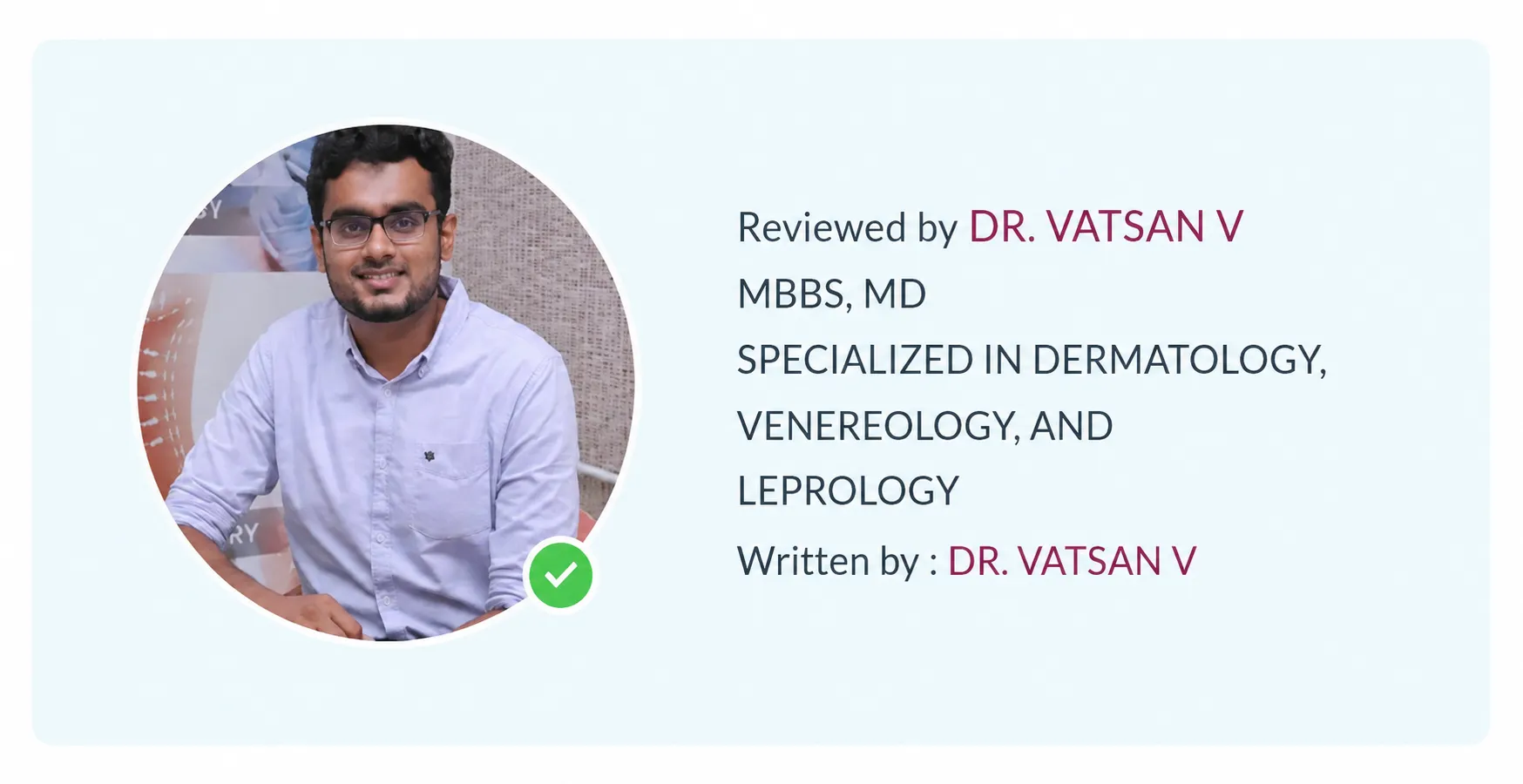
Medically reviewed (22 October 2026) by Dr. Vatsan V, Dermatologist, WEA Clinic, Velachery, Chennai. This article is for informational purposes and does not replace a personal consultation with a qualified doctor.
Direct Answer:
PRP Hair Treatment in Chennai
PRP hair treatment (platelet-rich plasma therapy) uses plasma prepared from your own blood and injected into the scalp to help manage certain types of hair loss. At WEA Clinic, Velachery, Chennai, Dr. Vatsan V, Dermatologist, assesses suitability and recommends treatment based on the cause of hair thinning. The first sitting of basic PRP treatment costs ₹5,499 and involves blood collection, centrifugation and scalp injections. Results vary, so ask about expected improvement and total course cost before committing to multiple sessions.
Worried about paying for multiple PRP sessions without seeing results? Before starting, understand the expected benefits, number of sessions, preparation method, alternatives and total estimated cost.
PRP Hair Treatment in Chennai: At a Glance
| Detail | Information |
|---|---|
| Treatment | Platelet-rich plasma (PRP) hair therapy |
| Chennai cost | Approximately ₹3,000–₹12,500 per session; prices vary by clinic |
| WEA Clinic price | ₹5,499 for the first sitting of basic PRP hair treatment |
| Preparation technique | Blood collection and centrifugation |
| Types | Single-spin and double-spin preparation |
| Procedure | PRP injections into selected scalp areas |
| Device | FDA-approved device |
| Doctor | Dr. Vatsan V, Dermatologist |
| Suitability | Selected patients after assessment of the cause of hair loss |
| Expected results | Variable; improvement, when it occurs, may take several months |
| Location | WEA Clinic, Velachery, Chennai |
1. How Much Does PRP Hair Treatment Cost in Chennai?
PRP hair treatment prices vary by clinic, preparation system and treatment plan. At WEA Clinic, the stated price for the first sitting of basic PRP hair treatment is ₹5,499.
| Sessions | Total at ₹5,499 per session |
|---|---|
| 1 session | ₹5,499 |
| 3 sessions | ₹16,497 |
| 4 sessions | ₹21,996 |
| 6 sessions | ₹32,994 |
These totals are calculations, not confirmed package prices or a recommendation for a particular number of sessions. Ask about the proposed course, follow-up appointments and additional charges before committing.
2. Can PRP Improve Hair Growth?
PRP uses a platelet-rich portion of your own blood, which is injected into selected scalp areas. Research suggests it may improve hair density in some people with androgenetic alopecia, or pattern hair loss. However, the degree of improvement varies, and some patients may see little benefit.
A dermatologist should first identify the cause of your hair loss. Pattern hair loss, nutritional deficiencies, thyroid problems and inflammatory scalp conditions may require different approaches.
Baseline photographs and scalp examination or trichoscopy can help measure progress over time.
3. What Tests May Be Needed Before PRP?
There is no single set of blood tests that every person needs before PRP hair treatment. Testing depends on your symptoms, medical history and scalp examination.
| Test or assessment | When it may be considered |
|---|---|
| Scalp examination or trichoscopy | To assess the pattern and extent of hair loss |
| Complete blood count (CBC) | If anaemia or another blood-related concern is suspected |
| Ferritin or iron studies | If iron deficiency is suspected |
| Thyroid function tests | If symptoms or history suggest a thyroid problem |
| Other investigations | When the history or examination points to another underlying cause |
Tell your dermatologist about your medications, supplements, medical conditions, allergies and any history of bleeding problems.
Before the procedure: Ask whether you need any specific preparation, whether your medications require review, and whether you should eat or drink normally. Do not stop prescribed medicines or supplements on your own.
4. How Is PRP Hair Treatment Performed?
- Assessment: The dermatologist examines your scalp and reviews your medical history.
- Blood collection: A small blood sample is taken.
- Centrifugation: The sample is processed to separate its components.
- PRP preparation: The platelet-rich fraction is prepared according to the system’s protocol.
- Scalp injections: PRP is injected into selected areas.
- Follow-up: The dermatologist assesses your response and discusses the next step.
Temporary tenderness, redness, swelling or pinpoint bleeding may occur. Ask about pain management and the clinic’s aftercare instructions before treatment.
5. PRP Aftercare: What to Do and Avoid
Aftercare instructions can vary depending on the preparation method, injection technique and your scalp’s response. Follow the instructions given by your treating dermatologist.
What to do after PRP
- Keep the scalp clean according to the clinic’s washing instructions.
- Follow the recommended timing for washing your hair and restarting your usual hair-care products.
- Attend follow-up appointments so your progress can be assessed.
- Contact the clinic if pain or swelling worsens or you develop symptoms that concern you.
What to avoid after PRP
- Avoid scratching, rubbing or aggressively massaging the injection sites.
- Avoid hair products or scalp treatments that irritate the treated area until your dermatologist says they are suitable.
- Ask when to resume strenuous exercise, swimming, sauna use and other activities that may irritate the scalp.
- Do not start, stop or change minoxidil, other medicines or supplements without advice from your clinician.
Mild tenderness can occur after injections. Seek prompt medical advice for increasing redness, spreading warmth, worsening pain, pus, fever or other signs of possible infection.
6. PRP vs GFC: What Is the Difference?
Both treatments use components prepared from a patient’s blood, but their preparation protocols differ. Their names alone do not establish which treatment will work better for an individual.
| Comparison | PRP | GFC |
|---|---|---|
| Full form | Platelet-rich plasma | Growth factor concentrate |
| Source | The patient’s own blood | The patient’s own blood |
| Preparation | Blood is processed to obtain platelet-rich plasma | Blood is processed to obtain a growth-factor-containing preparation |
| Administration | Commonly injected into selected scalp areas | Commonly injected into selected scalp areas |
| Evidence | Clinical studies suggest possible improvement in hair density, but protocols and results vary | Evidence is still developing; effectiveness depends on the protocol and available clinical research |
| Cost | Varies by clinic and treatment plan | Varies by clinic and treatment plan |
Which should you choose? Ask the dermatologist to explain the expected benefit, evidence, total cost and limitations of each option for your diagnosis. Do not assume GFC is more effective simply because it is described as more advanced.
7. PRP vs Minoxidil: Which Should You Consider?
PRP is an injectable procedure, whereas minoxidil is a medication used for certain types of hair loss. They differ in cost, convenience and ongoing treatment requirements.
| Comparison | PRP | Minoxidil |
|---|---|---|
| Treatment type | Scalp injections using prepared blood components | Medication, commonly applied topically |
| Where it is performed | In a clinical setting | Topical treatment is generally used at home |
| Treatment commitment | May involve multiple sessions and follow-up | Usually requires consistent use as directed |
| Suitability | Depends on the diagnosis and clinical assessment | Depends on the type of hair loss, formulation and medical suitability |
| Main consideration | Procedure cost, discomfort and variable response | Ongoing use, possible side effects and maintenance |
A 2025 systematic review and meta-analysis compared PRP with topical minoxidil across nine randomised controlled trials involving 451 participants. It did not establish a clear difference between the treatments in key outcomes such as hair density, terminal hair count and moderate-to-high regrowth. The studies also varied considerably. Read the study on PubMed.
Neither option is automatically best for everyone. A dermatologist can help decide whether one treatment or a combination is appropriate.
8. PRP Hair Treatment: Studies and Scientific Research
What does clinical research tell us about PRP for hair loss?
- 2024 systematic review and meta-analysis: Fourteen studies involving 431 participants were included in the qualitative review, with 13 included in the meta-analysis. The analysis found an increase in hair density, but the evidence was rated low quality, with substantial variation between studies and publication bias. Read the research.
- 2024 systematic review of male pattern hair loss: Eight randomised controlled trials and one prospective cohort involving 291 participants suggested potential improvements in hair density and hair count. Study quality and consistency remained limitations. Read the study.
- 2025 review of PRP preparation techniques: Three randomised controlled trials involving 90 participants compared single-spin and double-spin methods. No statistically significant difference in hair-density outcomes was established. Read the full study.
What do these findings mean? PRP has promising evidence for some forms of hair loss, but research does not guarantee an individual outcome or establish one universally best treatment protocol.
9. PRP Preparation Techniques and Equipment
PRP is commonly prepared using one of two centrifugation approaches:
- Single-spin: Blood undergoes one centrifugation step to separate its components.
- Double-spin: Blood undergoes two centrifugation steps to further separate or concentrate the platelet fraction.
The final preparation depends on the equipment, settings and protocol. More centrifugation steps do not automatically mean better hair growth.
FDA approval and FDA clearance are different regulatory statuses. A device’s status applies to its specific intended use; it does not automatically establish that PRP treatment for hair loss itself is FDA-approved.
10. PRP Treatment in Chennai: Dermatologist and Clinic Reviews
When comparing PRP providers in Chennai, look beyond star ratings. Check the dermatologist’s qualifications, whether the cause of hair loss is assessed, whether costs and limitations are explained, and whether follow-up is available.
Patient reviews can offer insight into communication, appointment experience and care. They cannot independently prove that PRP works or establish a clinic’s success rate.
Before booking, review the treating dermatologist’s professional profile and ask the clinic about the preparation method, expected treatment commitment and follow-up arrangements.
Frequently Asked Questions
How long does PRP take to show results?
If improvement occurs, it generally develops over several months. The timing and degree of response vary.
What if PRP does not improve my hair loss?
Ask the dermatologist to reassess the diagnosis and compare follow-up photographs or scalp measurements with your baseline. Discuss alternatives before paying for further sessions.
Can PRP be combined with minoxidil?
A dermatologist may recommend combination treatment for selected patients. Do not stop or change prescribed medication without medical advice.
Is PRP painful?
Blood collection and scalp injections can cause discomfort. The degree varies between individuals.
Discuss Your Hair Loss Concerns with WEA Clinic
If hair thinning is affecting your confidence or everyday life, a consultation can help identify the likely cause and determine whether PRP or another treatment is suitable.
WEA Clinic, Velachery, Chennai
Address: 40-A, 7th Street, Taramani Link Road, Tansi Nagar, Velachery, Chennai – 600 042
Phone: 82705 82706
Hours: 10 AM–8 PM daily
Consultation fee: ₹1,000
Contact WEA Clinic on WhatsApp
FILL FORM